
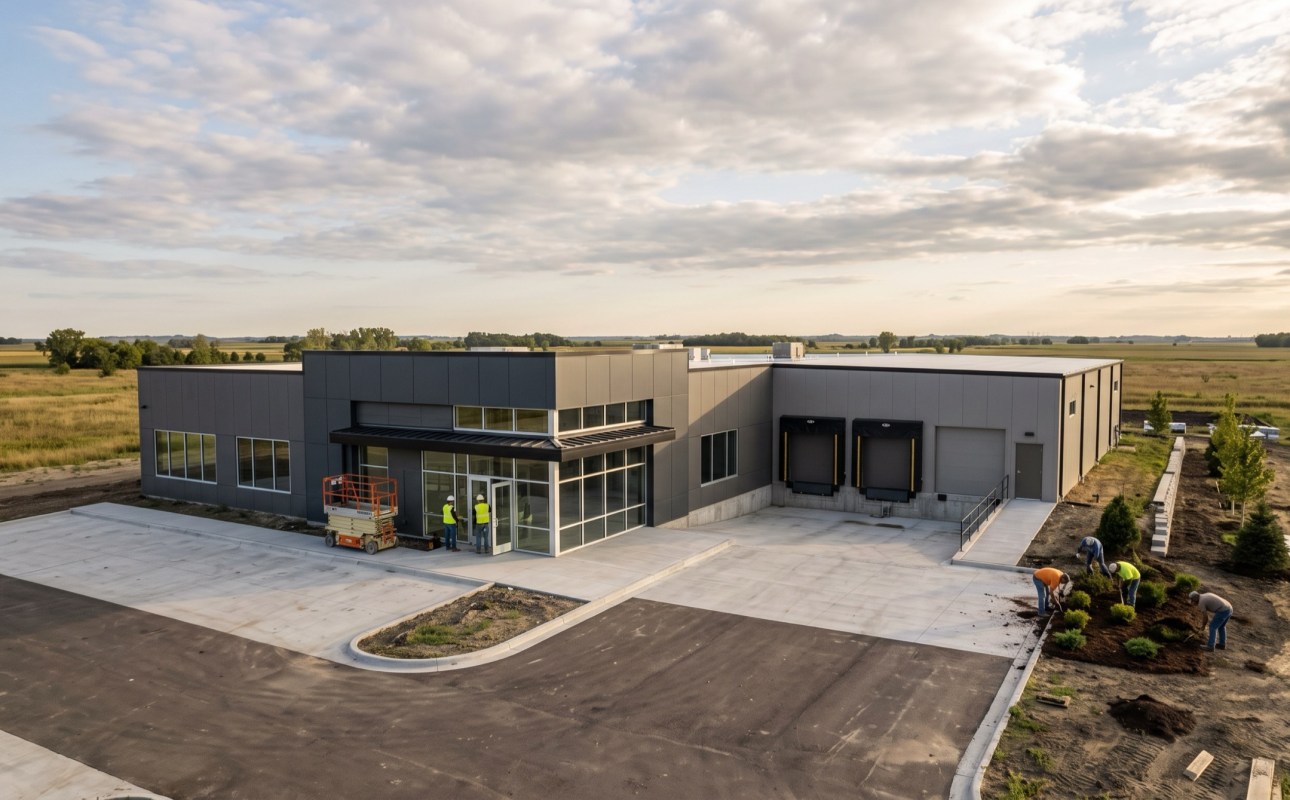
A build-to-suit lease is an agreement where a developer secures the site, then designs and builds a commercial facility to one tenant’s exact needs and leases it to that tenant long term. The tenant gets a new facility made for its operation without paying for the site and the build up front, and in return commits to a lease that usually runs 10 to 20 years.
That is the short answer to what is a build to suit lease. In commercial real estate it is often shortened to BTS, and it is common for offices, clinics, retail and industrial users. Below is how it works, who pays for what, how rent is set and what to negotiate, written from the owner’s side of the table in Minnesota.
How Does a Build-to-Suit Lease Work?
It works in 6 stages, and the lease is usually signed before anything is built. Nobody breaks ground until a tenant has committed.
- You define the requirements – square footage, layout, power, loading docks, ceiling height, parking and location.
- The developer finds the site and prices it: site, design, hard costs and soft costs.
- You sign the lease, with a work letter that spells out what will be built, to what standard and by when.
- The developer handles design, city approvals and the build, with your input on plans and finishes.
- The space is delivered, and rent usually starts once it is substantially complete and ready to occupy.
- You move in under a long term lease, and the developer or a later owner holds the property.
Plan well ahead. Industry guides put delivery at roughly 12 to 36 months depending on size, location and permitting, so most tenants start 1 to 2 years before they need to move.
Who Pays for What in a Build-to-Suit?
The developer pays for the site and the build, and the tenant pays rent plus most operating costs. Most of these deals use a net lease, often a triple net lease, so the tenant also covers property taxes, insurance and upkeep.
| Cost | Usually paid by |
|---|---|
| Site purchase | Developer |
| Design and engineering | Developer, built into the rent |
| Hard costs of the build | Developer, built into the rent |
| Upgrades beyond the agreed scope | Tenant, or added to the rent |
| Your own fit-out (furniture, equipment, racking) | Tenant |
| Property taxes and insurance | Tenant, under a net lease |
| Routine repairs and upkeep | Tenant, under a net lease |
| Major structural repairs | Depends on the lease: landlord under a triple net lease, tenant under an absolute net lease |
Some leases also include a tenant improvement allowance for the interior. Read exactly what it covers, because anything over it comes out of your pocket.
How Is Rent Set in a Build-to-Suit Lease?
Rent is based on the total cost of the project: the site, the build and soft costs like design, permits and financing. Because the landlord pays for all of it, the rent has to repay that cost over the lease term.
There are 2 common ways to set it:
- Fixed up front – The landlord prices the project at the start, so you know your number before work begins. Clear for budgeting, but the price includes a cushion for cost surprises.
- Open book – The final figure is a percentage of the actual project cost once the work is done. You see the real numbers, but your payment moves if costs rise.
Either way, it is usually higher than rent on standard space, because you are paying for space designed around you. A clear budget and a detailed scope of work protect you more than anything else in the deal.
Build-to-Suit vs Other Ways to Get a Building
There are 5 common ways a business gets a new facility. The difference is who builds it, who pays for it and who owns it.
| Option | Who builds | Who pays for construction | Who owns it after |
|---|---|---|---|
| Build-to-suit lease | Developer | Developer | Developer or landlord |
| Spec building | Developer, before any tenant signs | Developer | Developer or landlord |
| Ground lease | Tenant, on a leased site | Tenant | Tenant owns the improvements during the lease |
| Reverse build to suit | Tenant manages construction | Landlord funds it | Landlord |
| Sale-leaseback | You already own it | You did | Investor buys it and leases it back to you |
A spec building is made for a general type of user, common in industrial parks, and is faster to move into, but you take the layout as it is. A reverse build to suit fits companies with their own construction know-how. A sale-leaseback works for an owner who wants to turn the equity in its real estate into cash while staying in place.
Pros and Cons of a Build-to-Suit Lease
The biggest advantage is a facility made for how you work, without tying up your own capital. The biggest drawback is a long, firm commitment.
Advantages for the tenant
- A new facility designed around your operation, not adapted from someone else’s.
- Your capital stays in your business instead of in real estate.
- The landlord carries the risk during the build: delays, material costs and financing.
- New construction usually means lower repair costs in the early years.
Disadvantages for the tenant
- Rent is usually higher than standard space.
- The lease term is long, often 10 to 20 years, and hard to exit if your business changes.
- Developers and their lenders expect strong tenant credit.
- You wait for the build instead of moving in now.
What to Negotiate Before You Sign
The work letter and a handful of dates decide most of the risk. The work letter is, in effect, a short construction contract inside the lease.
- The scope and standard of the work, in writing, down to the details that matter to your operation.
- The delivery date, and what happens if the developer misses it, such as rent credit for each day of delay.
- When rent starts, tied to the building being substantially complete and legally ready to occupy.
- The certificate of occupancy: the landlord usually gets it for the base shell, and you handle permits for your own improvements, so define where one ends and the other begins.
- How change orders are priced and approved, and who pays for them.
- The lease term, rent increases and renewal options.
- Repair duties, especially roof and structure.
- Room to expand on the site later.
This is where an owner’s representative earns the fee: someone who has worked both sides can tell you which promises are realistic and which need to be in writing. See how much an owner’s representative costs.
Is a Build-to-Suit Right for Your Business?
It makes sense when nothing on the market can do the job and you can commit for the long term. It is the wrong call when an existing property would work with some changes, or when you are not sure where your business will be in 10 years.
It tends to fit when:
- Your operation needs something specific: heavy power, industrial clear heights, medical layouts, loading, drive-through or a particular location.
- Nothing available fits without a major and costly renovation.
- You would rather keep your capital in the business than own the real estate.
- You can commit to a long term lease.
If you are not sure, define the requirements before anyone draws a plan. A planning engagement like Inventure BLUEPRINT answers whether to build, lease, buy or stay put.
Build-to-Suit in Central Minnesota
In Minnesota, the schedule and the budget are often set before work starts: city approvals, zoning and PUDs, utility and access charges, and a building season that does not forgive a late start. Brokers who follow the Twin Cities market point to St. Cloud for lower land costs and more flexible zoning, especially for industrial and manufacturing users, which makes Central Minnesota a strong place for custom development.
Inventure Real Estate develops build-to-suit and lease-back projects and represents owners through the build, with brokerage, development and property management under one roof in St. Cloud. Our CEO, Doug Boser, started on the construction side of the table in 1989 and has worked on the owner’s side since 2000. See what we have delivered on our build-to-suit page.
If you are planning a new facility in Central Minnesota, tell us what the building has to do or call (320) 980-2300. Learn more about our real estate development work, or ask about Inventure BLUEPRINT if you are still deciding.
Frequently Asked Questions
Build-to-suit, or BTS, means a facility is designed and built to one tenant’s specific needs before that tenant moves in. The developer pays for the site and the build, and the tenant leases it long term.
The developer or landlord usually owns it, and the tenant leases it. The landlord may keep the property or sell it to an investor once the tenant is in place, and the lease stays in force either way.
The developer pays for the site, design and build up front. The tenant repays that cost through rent over the lease term and, under a net lease, also pays property taxes, insurance and maintenance.
Most run 10 to 20 years, and longer for highly specialized facilities. The long lease term gives the owner time to recover the cost of space made for one user.
In a build-to-suit, the developer builds and owns the finished space and you lease it. In a ground lease, you lease only the land and build and pay for the structure yourself.



1 Comment
[…] expensive in any market, and we cover the 10 most common ones here. If no existing space fits, a build-to-suit lease may be the better […]