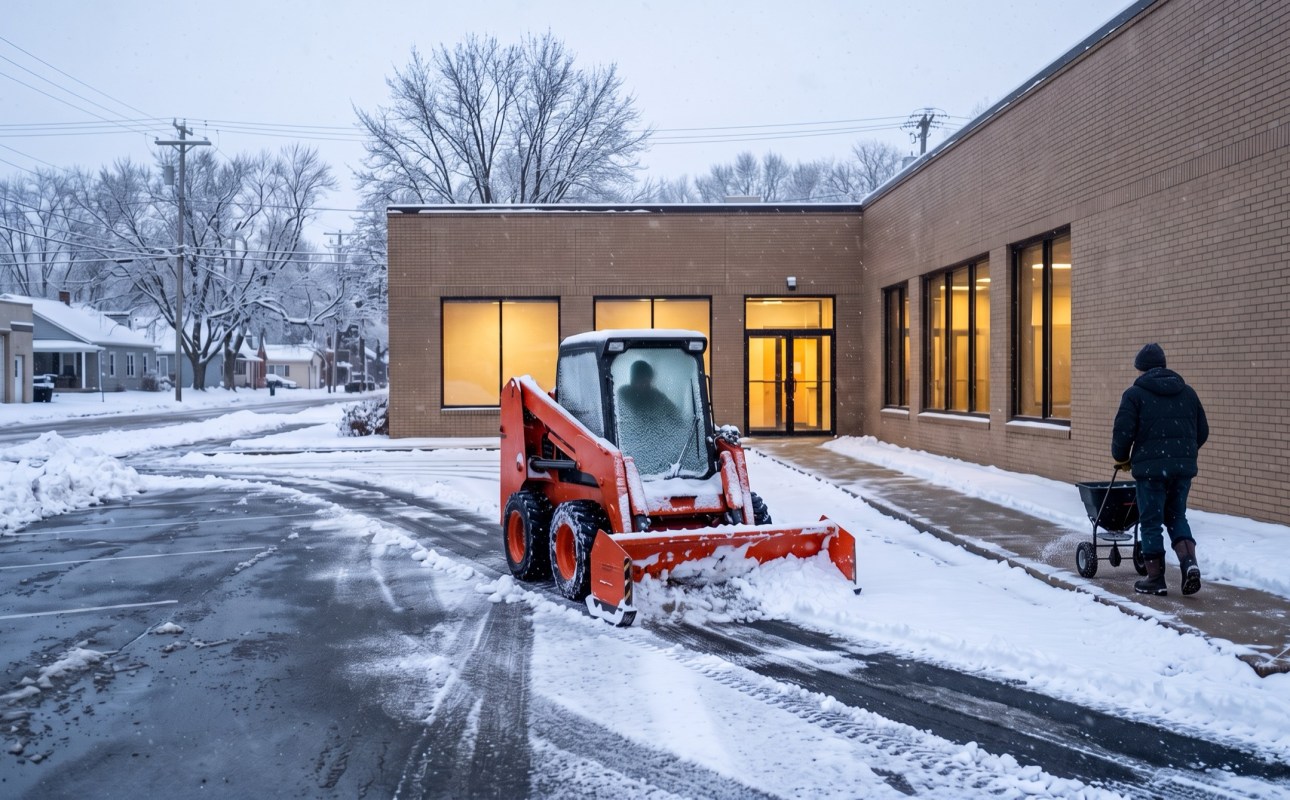
Commercial building winter maintenance comes down to 5 jobs: keep the heat at 55°F or higher, keep the sprinkler riser and any wet sprinkler pipe at 40°F or higher, keep roof drains open, clear public sidewalks within 24 hours of a snowfall, and know who answers a no-heat alarm at 2 a.m. Most winter damage starts with one of those 5 slipping, usually on a cold night when nobody is in the building.
This is the checklist we use for commercial property in Central Minnesota, where a long winter of snow, ice and below zero nights tests every roof, pipe and boiler. It covers what to do, when to do it, and who is responsible under a typical lease.
What does commercial building winter maintenance include?
It includes the heating systems, pipes and sprinklers, the roof and its drains, snow and ice on walks and the parking lot, and a plan for after-hours failures. The numbers below come from insurers and city rules, and they are the ones to post in the mechanical room.
| Item | The number | Source |
|---|---|---|
| Inside temperature, occupied or not | 55°F minimum | Insurance Institute for Business & Home Safety (IBHS) |
| Wet sprinkler system and dry system riser room | 40°F minimum | Cincinnati Insurance loss control |
| Temperature alarm setting | Alert before a space drops to 40°F | Cincinnati Insurance |
| Old plus new snow on a roof | 2 feet of each can weigh up to 60 pounds per square foot | IBHS |
| Public sidewalk | Cleared within 24 hours after the snow stops | St. Cloud city rule |
| Rock salt | Untreated salt stops working below 15°F | Saint Paul |
Burst pipes are the leading cause of property damage from winter weather, according to IBHS. That is why heat and water get the first 2 rows, and why frozen pipes come up again and again below.
When should you start winterizing a commercial building?
Start in September or October, before the first hard freeze, and treat winter as part of year round facility maintenance rather than a one time project. Fall work should confirm a building that was cared for all year, not make up for repairs that were put off.
| Month | What gets done |
|---|---|
| September | Book HVAC service, sign the snow contract, order filters, belts and spare parts |
| October | Service boilers, furnaces and rooftop units; test freeze stats; clean gutters and roof drains; drain irrigation lines; add insulation to exposed pipe |
| November | Test temperature alarms and the call list; check exterior lighting; put down walk-off mats; stock salt and sand |
| December to February | Roof inspections after every big storm; clear drains; watch snow depth and drifts; log every plow and salting visit |
| March and April | Watch for ice dams and leaks in the thaw; look for roof and parking lot damage; review the winter’s work orders and plan repairs |
In Minnesota, roof, paving and exterior repairs found in March go on the list for the construction season. Booking the contractor early matters, because other property owners found their damage in March too. Our build-to-suit timeline shows how that season shapes any outdoor work.
How do you get the heating system ready?
Have every boiler, furnace and rooftop unit serviced by a licensed HVAC contractor before outside temperatures drop below zero, and settle an emergency rate while you are at it. A heating failure in January is an emergency, not a work order for Monday.
The service should cover:
- Filters and belts replaced
- Heat exchangers checked for cracks, which can leak carbon monoxide
- Freeze stats in air handlers tested, so a unit shuts its outside air damper before a coil freezes
- Burners cleaned and flues and vents cleared
- Thermostat schedules set so no zone drops below 55°F overnight or on weekends
- Carbon monoxide detectors and smoke alarms tested
Twice a year HVAC service, once before heating season and once before cooling season, is common for commercial buildings. Ask the contractor for a written list of equipment near the end of its life. A unit that limps through October is the one most likely to quit when temperatures hit their low for the year.
If the building has a generator, run it under load in the fall and confirm it can power the HVAC equipment. A generator that only runs the lights does not stop a freeze.
How do you keep pipes and sprinklers from freezing?
Keep the whole building at 55°F or higher, keep any space with sprinkler pipe at 40°F or higher, and put a temperature alarm in each room most likely to get cold. Water lines on outside walls, above ceilings near the roof, in loading docks and in unheated vestibules go first.
- Add insulation to exposed water lines, and heat trace in spots that cannot be kept warm
- Seal gaps where pipes pass through outside walls, because a small draft can leave a pipe freezing in a heated room
- Shut off, drain and blow out irrigation and outside hose lines
- Label the main water shutoff and make sure more than one person can reach it
- Consider an automatic excess flow valve, which shuts off the water when a broken pipe starts running
Frozen pipes in fire protection lines are their own problem. A wet system needs the building at 40°F or warmer. A dry system still needs heat in the riser room, where the main valve brings water into the building. A frozen line is often not found until it thaws and starts leaking, so check the riser room every week in deep cold.
How much snow can a commercial roof hold?
It depends on how the roof was designed, so the real answer comes from a structural engineer or the building’s structural drawings. The type of snow matters as much as the depth: IBHS notes that 2 feet of old snow plus 2 feet of new snow can weigh up to 60 pounds per square foot.
For comparison, Minnesota sets the roof snow load for homes at 35 pounds per square foot in the south of the state and 42 in the north, according to University of Minnesota Extension. Every commercial property roof has its own design load. Metal and pitched roofs shed snow better than flat roofs, which hold it until someone removes it.
Watch the spots that collect more than their share of load:
- Drifts against parapets, taller walls and mechanical equipment
- Low roofs next to a taller building
- Areas around roof drains, where ice dams form on flat roofs and trap water
- Ponding where a drain is blocked or the deck has sagged
After a big storm, look for the warning signs of a snow load problem: creaking, a roof line that sags, new cracks in ceilings or walls, water stains, and doors that suddenly stick. If you see any of them, get people out of that area and call a professional before anyone goes on the roof.
Ice dams on a flat roof usually start with warm air escaping around penetrations, skylights and equipment curbs. Regular inspections keep drains, scuppers and downspouts clear all winter, not just in the fall. Do not chip ice off the membrane, which can tear the roof and cause the leak you were trying to prevent.
How do you handle snow and ice on sidewalks and parking lots?
Put a signed snow removal contract in place before the first snow, with a trigger depth, a response time and a salting plan. Then clear public sidewalks on the city’s deadline, which in St. Cloud is within 24 hours after the snow stops, across the full width of the sidewalk on every side of the property.
Snow and ice rules differ, so check the city where the building sits:
| City | Commercial sidewalk deadline |
|---|---|
| St. Cloud | Within a day after snowfall ends; corner lots clear curb cuts to the street |
| Saint Paul | 24 hours |
| Minneapolis | 4 daytime hours (8 a.m. to 5 p.m.) after it stops snowing |
All 3 cities bar pushing snow into the street, and St. Cloud and Minneapolis can clear a sidewalk and bill the property owners.
A good snow removal contract covers:
- Trigger depth for plowing and when salting starts
- Which parking areas, walks, entrances, loading docks and fire lanes are included
- Where snow gets piled, away from drains, hydrants and sight lines in the parking lot
- A current certificate of insurance every year
- A written log of every visit, with date, time and what was done
Untreated rock salt stops working below 15°F, and more of it does not melt more ice. Saint Paul notes that about 12 ounces, a coffee mug, treats a 20 foot driveway, and the Minnesota Pollution Control Agency runs smart salting training for crews.
Inside the doors, walk-off mats keep slush off floors and cut slip and fall risk at the entrance. Check exterior lighting too: in December, people arrive at and leave a business in the dark.
Who is responsible for winter maintenance, the owner or the tenant?
The lease decides. In a triple net lease the tenant often pays for snow removal, heating service and repairs, while in a gross lease the owner usually handles them and builds the cost into rent or shared charges. Trouble starts when the lease is vague and everyone assumes someone else called the plow.
| Task | Owner | Tenant | Property manager |
|---|---|---|---|
| Roof, drains and structure | Usually | Rarely | Schedules inspections |
| Heating service | Depends on the lease | Often, if triple net | Books and tracks it |
| Snow contract | Common in multi-tenant buildings | Common in single tenant buildings | Hires and supervises the crew |
| Inside temperature | Sets the rule | Follows it | Monitors alarms |
| City sidewalk deadline | On the property owner | By agreement | Makes sure it happens |
If you own the building, read the maintenance and repair sections of each lease before November. If you rent space, the same sections tell you what you will be billed for. Our post on 10 mistakes St. Cloud business owners make when leasing covers the clauses to read, and our commercial real estate terms guide explains how each type of lease splits the costs.
What happens when something fails at 2 a.m.?
Someone has to get the alarm, decide what it means, and get a technician to the building fast. A broken boiler at 2 a.m. is a repair. The same failure found on Monday morning can mean frozen pipes, wet ceilings and a closed business.
Before winter, write down:
- Who gets the temperature alarm and the sprinkler alarm, with a backup name
- Which heating, plumbing, roofing and restoration contractors to call, with after-hours numbers and the emergency rate you agreed on
- Where the water shutoff, gas shutoff and electrical panels are
- Who can let a contractor into the building at night
- How to reach the people in the building if heat or water will be off
Check that alarm settings and freeze protection sequences in the building control systems work the way they should, and that alerts reach a phone that someone answers. If you have a loss, take photos and video, protect the space from more damage, and call your insurance company right away.
This is the part of facility maintenance that is hardest for a business owner to cover alone. Inventure’s Facility Services team handles maintenance and repairs, tenant requests and 24/7 emergency response through a trusted vendor network, so the call at 2 a.m. goes to someone whose job it is. Brokerage, development, owner’s representation and property management sit under the same roof in downtown St. Cloud, so the people who answer that call know the building. For Central Minnesota owners, that means one facility team for routine work and emergency calls alike.
What changes for a vacant or part-time building?
A vacant or part-time commercial property needs more attention in winter, not less. IBHS notes that vacant buildings are more exposed to pipe bursts because inside temperatures swing and no one is there to notice a problem.
- Keep the heat at 55°F or higher, even in an empty suite. Saint Paul tells businesses to keep at least 50°F when they are closed, and 55°F is the safer line
- Walk the space at least weekly, including above the ceiling near outside walls
- Keep alarms active and tied to a person, not just a panel
- Keep the snow contract in force so entrances and fire lanes stay clear
- If the space will sit empty all winter, ask a plumber whether to drain the lines and what your insurer requires
Property owners should know that an empty suite that freezes can damage the suites next to it. In a multi-tenant facility, the cost of heating an empty space is small next to a water claim that runs through 3 tenants.
Frequently asked questions
Start in September or October, before the first hard freeze. Book HVAC service and the snow contract early, because contractors fill their fall schedules fast. Finish alarms, mats and salt by mid November.
Keep it at 55°F or higher, even when it is closed, which is the IBHS guideline to prevent frozen pipes. Any space with sprinkler pipe or a sprinkler riser needs 40°F or higher at all times, even in the coldest temperatures of January.
There is no single depth, because it depends on the roof’s design and how heavy the snow is. Wet, packed snow and ice weigh far more than fresh powder. Ask a structural engineer for your roof’s snow load, and watch drifts near walls and equipment.
The city holds property owners responsible for public sidewalks. Between owner and tenant, the lease decides; in a triple net lease the tenant often pays, and in multi-tenant buildings the owner or property manager usually hires one contractor for the whole site.
Twice a year is common: once before heating season and once before cooling season. HVAC systems in Minnesota should be serviced before the first cold week in fall, along with regular inspections through the winter.
Keep the heat at 55°F or higher, seal drafts at outside walls, add insulation to exposed pipe and keep alarms tied to a person who will answer. Walk the space weekly. If it will be empty all winter, ask a plumber about draining the lines. Want help getting your commercial property ready for winter? Contact our property management team or call (320) 980-2300. To see how Inventure handles buildings day to day, read what a commercial property management company does, learn about our property management service, see our projects, or download the Property Management Playbook.