
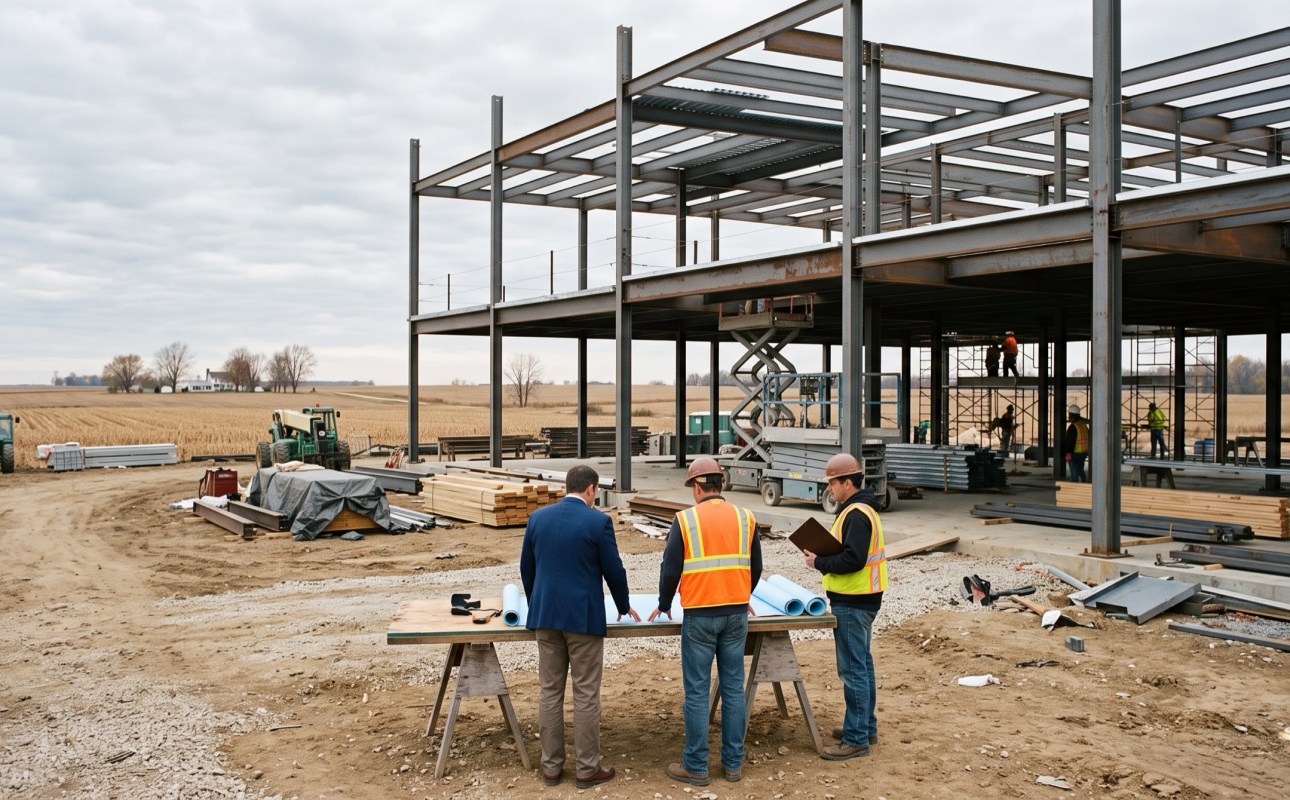
A general contractor builds your building, a construction manager runs the construction process, and an owner’s rep works only for you and watches over all of it. The fastest way to tell them apart is to ask 2 questions: who holds the trade contracts, and who carries the risk if the job costs more?
That is the short answer to owner’s rep vs construction manager vs general contractor. The roles overlap, and the same title can mean different things on 2 different projects. Doug Boser, our CEO, has been on the construction side of the table since 1989 and the owner’s side since 2000, so here is how each seat works on a construction project and how each one thinks when money is on the line.
What Is the Difference Between an Owner’s Rep, a Construction Manager and a General Contractor?
The difference is who they work for, who they hire and what they stand to gain or lose on your project. A construction manager comes in 2 types, so the table splits that role in 2.
| Factor | Owner’s rep | Construction manager, adviser | CM at risk | General contractor |
|---|---|---|---|---|
| Who they work for | Only the owner | The owner | The owner, by contract | The owner, by contract |
| Main job | Protect your budget, schedule and scope | Coordinate and advise | Plan, then build | Build |
| Holds trade contracts | No | No | Yes | Yes |
| Carries construction risk | No | No | Yes | Yes |
| How they get paid | Percentage, retainer or fixed fee | Fixed fee, hourly or percentage | Fee under a guaranteed maximum price | Bid price, profit is what is left after cost |
| When they join | Before design, ideally | During design | During design | Often after design |
| Works on the job site every day | No | Sometimes | Yes | Yes |
All 4 can be hired by the owner on commercial projects. They do not all sit on the same side of the table.
What Does a General Contractor Do?
A general contractor is the builder. The GC hires the subcontractors, schedules the work, handles procurement of materials, runs the site day to day and has responsibility for quality and for delivering what the contract documents show.
On a traditional design-bid-build project, the owner hires an architect, the design gets finished, and general contractors bid on it. The GC commits to a defined scope for a set price and time. If the job costs less than the bid, the GC keeps the difference. If it costs more, the GC absorbs it, unless the extra cost comes from a change to the scope.
That last part matters. A good general contractor is not your enemy, and most want a happy owner. But the GC runs a business, and profit comes from the gap between the bid and the actual cost. A GC is responsible for building what the drawings show. It is not the GC’s job to ask whether the drawings are the right building for your business.
What Does a Construction Manager Do?
A construction manager handles the planning, coordination and project management of the construction process, usually starting during design. The important question is which kind you are hiring, because the title covers 2 very different contracts.
Construction manager as adviser
A construction manager as adviser, also called an agency CM, is a paid consultant. This CM reviews constructability, estimates cost and helps manage the schedule, but does not hold the trade contracts and takes no financial risk for the work. The owner signs with the contractors directly, so the owner keeps more control and also keeps the cost risk.
CM at risk
A CM at risk starts as an adviser during design, then becomes the builder. Once the design is far enough along, the CM commits to a guaranteed maximum price and takes over the subcontractors. Costs above that cap are the CM’s problem, and savings below it are often split, with published splits of 75/25 or 70/30 in the owner’s favor.
In plain terms, a CM at risk is a general contractor who came to the project earlier and works under a different contract. That can be a great way to manage a complex project. You get early input and a ceiling on the price. Just do not confuse it with having someone independent on your side.
What Does an Owner’s Rep Do?
An owner’s rep, short for owner’s representative, is the person who works only for you across the whole project. This person does not design, does not build and holds no trade contracts. The job is to protect your money and your schedule across the whole project, including the soft costs that sit outside the construction contract.
Here is what that looks like on our projects:
- Early – Get involved before design begins, while the decisions that set the budget are still open
- Team – Help you hire the architect, pick the builder and choose how the project will be delivered
- Procurement – Read every bid and compare what each one leaves out
- Construction – Be your eyes and ears on the project site, and read all pay applications and change orders before you sign
- Closeout – Stay through the punch list and final documents
For the longer version, read what an owner’s representative does and when you need one.
Who Carries the Risk on a Construction Project?
The builder carries the risk of delivering what the contract says, and the owner carries the risks of everything the contract does not say. A GC or CM at risk stands behind price, quality and time for the defined scope. An adviser CM and an owner’s representative carry no construction risk at all.
So where do owners get hurt? Usually in the gaps. Work that was never drawn becomes change orders. Late decisions become delays, and you carry rent, interest and payroll on a building you cannot use. Bids can come in above projections after the design money is spent. A contract moves some risks to the builder, but it cannot make your early project decisions for you. That takes oversight.
How Does Each One Get Paid, and Why Does It Matter?
Each role is paid differently, and that shapes the advice you get. Ask who makes more money if your project gets more expensive.
- General contractor – Usually a lump sum or a cost plus contract. Profit comes from the difference between price and actual cost, and added work is priced separately
- CM at risk – A fee plus the cost of the work, capped by the guaranteed maximum price
- Construction manager as adviser – A fixed fee, an hourly rate or a percentage of the work
- Owner’s rep – Typically 1% to 5% of construction costs, or a retainer or fixed fee. See what an owner’s rep costs for the ranges
Doug ran a construction company before switching sides, so he knows how builders price and schedule. There is nothing wrong with a fair profit. It just means the person pricing a change order should not be the only one reviewing it.
When Does Each One Join the Project?
An owner’s rep should come first, a construction manager joins during design, and a general contractor often comes last. The order matters because most of the budget gets set before work starts.
An owner’s rep can start before you pick a site. That is when you are still deciding whether to build, expand or relocate, which is the work behind our Inventure BLUEPRINT. In Central Minnesota, early planning also has to account for city approvals, water and sewer access charges and the Minnesota construction season. Those decisions are already made if the GC arrives after the design is done.
Can a Construction Manager Be Your Owner’s Rep?
An adviser CM can do much of the same work, and on some jobs the 2 roles overlap. A CM at risk or general contractor cannot be your owner’s rep, because no one can independently check their own price.
Titles are used loosely, so test the relationship instead of the label:
- Who holds the trade contracts?
- Do you or your parent company have construction or design arms?
- How are you paid, and does your fee go up if the project cost goes up?
- Will you get paid by anyone other than me on this project?
The right answers mean no stake in the construction contract and no loyalty to any contractor or subcontractor.
How Do the 3 Roles Work Together?
The owner’s rep speaks for the owner, the construction manager handles coordination of the work, and the general contractor directs the subcontractors. Good communication runs through 1 weekly meeting and 1 set of records, so everyone works from the same numbers.
When a problem comes up, such as a change order the contractor sees as extra work and the architect sees as already drawn, the owner’s rep lays out your options and you decide. Clear responsibilities keep the project moving, and they help you manage risks before they grow. That clear line of communication is what keeps a disagreement from turning into a delay.
Do You Need an Owner’s Rep and a General Contractor?
Yes, if you hire an owner representative you still need a builder to manage the work. These are the common combinations for commercial projects:
| Your project | Common team | Why it works |
|---|---|---|
| Simple project, finished design, experienced owner | Architect and GC | 1 point of responsibility and a set price |
| First building, no construction staff, limited time | Owner’s rep, architect and GC | Someone reviews bids, changes and payments for you |
| Tight schedule or a complex building | Owner’s rep, architect and CM at risk | Early cost input, a price cap and independent oversight |
| Large program with several contractors | Adviser CM or owner’s rep, plus contractors | Coordination stays on the owner’s side |
Be honest about the first row. If you have someone in house who has built before and has the time, you may not need outside help. Owners of clinics, banks, offices, production buildings and churches have usually never done this before, and they are also running a business.
Frequently Asked Questions
Yes. A GC is the company that holds the contract to build, while a project manager is a person who runs the work. Most GCs employ project managers, and project management can also sit on the owner’s side.
Most commercial GCs do not charge by the hour. They price the whole job through a lump sum or a cost plus contract, so compare the total price and what it includes, not an hourly rate.
On a contractor’s team, a project manager usually reports to a project executive or the company’s leadership. On your project, the person at the top is you as the owner, and an owner’s rep speaks for you.
Watch for a bid far below the others, a vague scope, no clear process for change orders and weak references on similar projects. A low number often means something was left out, so have someone compare the bids line by line.
Do not agree to changes out loud or tell a contractor to go ahead before you have seen the price in writing. Also hold back your top budget number until you have real pricing, so the bids reflect the work and not what you can spend.
Some do, because a GC takes on real financial risk on every bid. Protect yourself by checking how long they have been in business, asking for lien waivers with each payment and never paying far ahead of the work completed.
Talk to Someone on Your Side of the Table
If you are planning a building in St. Cloud, Sartell, Sauk Rapids, Waite Park or anywhere in Central Minnesota, we can help you sort out which roles your project needs and how to manage them. Inventure has owner’s representation, real estate development, brokerage and property management under one roof in downtown St. Cloud, and you can see the kind of work we do on our projects page.
Tell us what you are building or call (320) 980-2300. Want to read first? Download the Owner’s Building Playbook.


