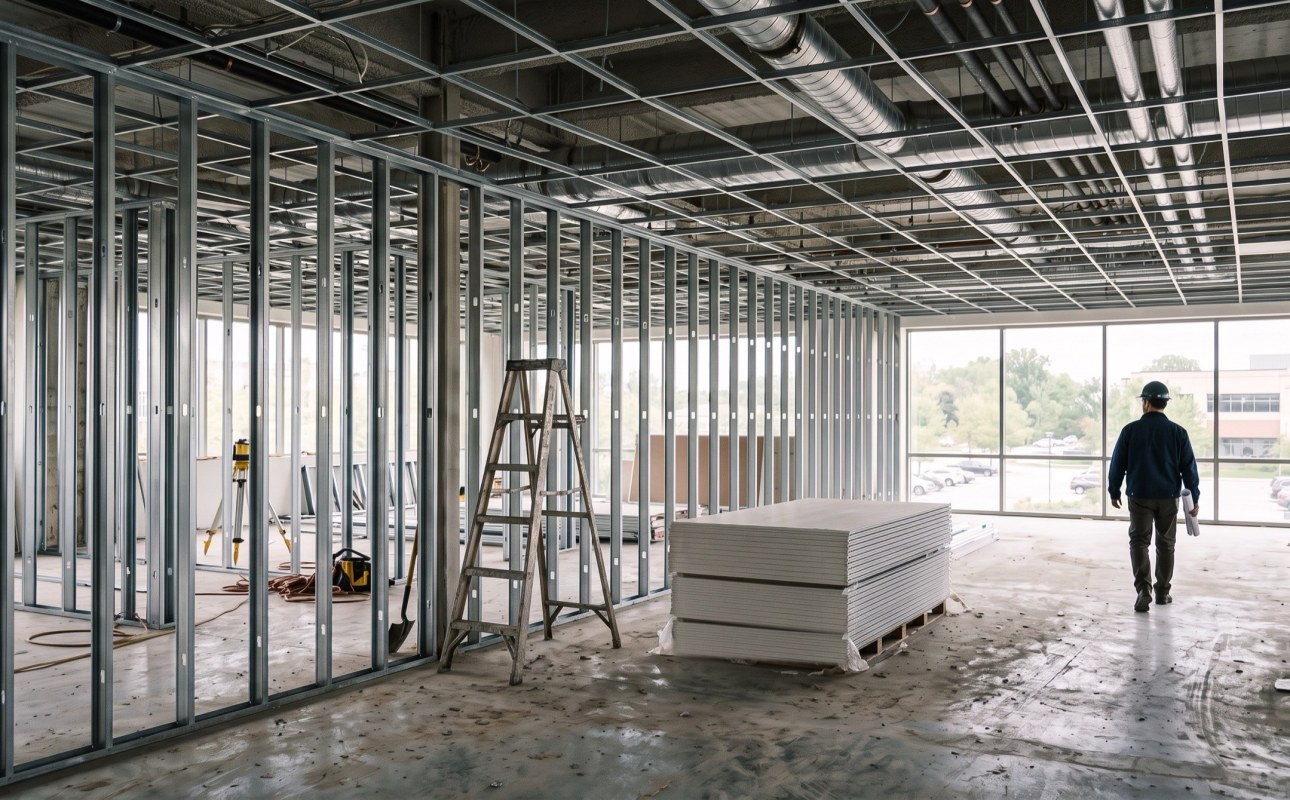
A tenant improvement allowance is the money a landlord agrees to put toward building out a leased commercial space, typically written as a dollar figure per square foot. Published 2026 ranges run from $3 to $15 per square foot for industrial space up to $50 to $120 for office, and the tenant pays whatever the buildout costs above that amount.
You will also see it called a TIA or a TI allowance. The headline number gets the attention in a commercial lease, but what a TIA covers, when it gets paid and who runs the work decide what it is really worth. Here is how it works, written from the owner’s side of the table in St. Cloud, Minnesota.
What Is a Tenant Improvement Allowance?
A TIA is a landlord’s contribution toward the cost of turning a space into one your business can use. It is negotiated as part of the lease, and it pays for tenant improvements such as walls, flooring, lighting and electrical work.
Most commercial space is not ready on day one. A clinic needs exam rooms and plumbing. A bank branch needs a new layout. The allowance is how the landlord and the tenant share that cost. In commercial real estate it is a standard part of the deal, because the landlord ends up with an improved building and a tenant who has signed for a long term.
It is not free money, though. The landlord recovers those funds through the rent over the life of the lease, which is why a longer term supports a bigger amount.
What Is an Example of a Tenant Improvement Allowance?
Say you lease 3,000 square feet and the landlord offers $30 per square foot. The math is $30 x 3,000 = $90,000 toward your buildout.
Check one detail first. The lease may set the figure per rentable square foot or per usable square foot. Those are different numbers, and the gap between them can change the total.
How Much Is a Reasonable Tenant Improvement Allowance?
A reasonable TIA depends on the property type, the state of the space and the length of the term. Office deals often run around $10 for each year of term, so a 5 year lease would land near $50 per square foot.
These are published 2026 industry ranges for what commercial real estate landlords offer tenants:
| Space type | Typical range per sq ft | Why |
|---|---|---|
| Industrial or warehouse | $3 to $15 | Minimal finish, mostly functional work |
| Second-generation space | $10 to $30 | A prior tenant’s buildout is already there |
| First-generation retail (shell) | $40 to $80 | Raw space needs extensive work |
| Office | $50 to $120 | Varies by finish level and lease length |
| Medical | $60 to $150 | Plumbing, power and compliance add cost |
| Restaurant | $100 or more | Kitchens are among the most expensive buildouts |
Treat these as a starting point, not a local quote. No published market range replaces real bids on your own scope.
What Changes the Number?
4 things move the number up or down:
- Term – A longer lease gives the landlord more years to recover the money. A 2 year lease rarely comes with much.
- Tenant credit – Strong financials and a stable business lower the landlord’s risk.
- Market – When space sits empty, landlords offer more. In a tight market they do not have to.
- Starting point – A shell space warrants more than a second-generation space that needs a refresh.
What Does a Tenant Improvement Allowance Cover?
An allowance pays for hard costs, the physical construction work, and sometimes soft costs like design and permits. It rarely covers anything you can pick up and take with you.
| Item | Covered? |
|---|---|
| Demolition, walls and framing | Yes |
| Flooring, ceilings, doors and paint | Yes |
| Electrical, plumbing, HVAC and lighting | Yes |
| Architectural and engineering fees | Sometimes |
| Permit fees | Sometimes |
| Project management fees | Sometimes |
| Data cabling and security systems | Often not |
| Signage | Often not |
| Furniture, computers and business equipment | No |
| Moving expenses | No |
The first 3 rows are hard costs and the next 3 are soft costs. None of this is standard. The list of eligible costs belongs in the work letter, the document attached to the lease that describes what gets built. If an item is not listed, the landlord can refuse to reimburse it after the work is done. Landlords often limit the money to construction costs, so get design and permits inside the definition.
What Does Central Minnesota Add to the List?
Local charges can land outside the allowance if nobody asks. Cities can bill water and sewer access charges (SAC/WAC) when a space adds plumbing or changes use, and plans still have to meet local building codes and ADA requirements. Ask the city early in Sartell, Waite Park or wherever you are leasing, then ask the landlord whether the allowance can pay those charges.
How Does the Allowance Get Paid?
In most deals the allowance is a reimbursement, not a check up front. You pay the contractor first, then the landlord pays you back, so you need the cash or a line of credit before work starts.
The process typically goes like this for tenants running their own project:
- You hire the contractor and pay the construction costs as the work moves along.
- The work is finished and inspected, and the city issues a certificate of occupancy.
- You submit invoices, proof of payment and lien waivers from your contractors.
- The landlord reviews the paperwork and sends payment up to the agreed amount, as a lump sum or as rent credits over several months.
Some landlords pay the contractor directly, and some release funds in stages against invoices during construction. Stage payments are far better for your cash. Each condition on the money can be reasonable alone, but together they can delay reimbursement by months.
What If the Buildout Costs More or Less Than the Allowance?
If it costs more, you pay the difference. If your buildout costs $80,000 and your allowance is $60,000, the remaining $20,000 is yours.
Some leases offer an amortized allowance, where the landlord funds the extra and adds it to your rent over the term. That is a loan with interest, so compare what it costs against a bank. It also has to be in the lease before you sign.
If it costs less, the landlord typically keeps the unused portion. You can ask for unused funds to become free rent or a rent credit, but that has to be negotiated into the lease.
How Does the Deadline Fit a Minnesota Construction Season?
Most allowances expire, often 12 to 18 months from the start of the lease, and any money not used is forfeited. That sounds like plenty of time until you count a Minnesota winter.
Interior work can go on all year. Anything outside moves slower: rooftop units, new entrances, parking lot changes and utility connections. Add design, landlord approval of the plans and city review, and a lease signed in the fall can use up months before the hard work starts. Build your schedule first, then make sure the deadline and the rent start date fit it. Otherwise you carry rent on a space you cannot use yet, and a TIA does nothing to fix that.
Who Manages the Buildout?
The lease decides who runs the work, and there are 3 common setups. The trade is always control against risk.
| Setup | Who runs the project | Who carries overruns | Best when |
|---|---|---|---|
| Tenant-controlled | You pick the architect and contractor | You | You want control of the design and the budget |
| Landlord-controlled | The landlord’s team, with your input | Depends on the lease | The building’s standard finishes work for you |
| Turnkey | The landlord delivers finished space to an agreed spec | The landlord | You want a simple process and a set result |
With a tenant-controlled project, somebody has to watch the money. The check depends on paperwork, and missing lien waivers or unapproved change orders can hold up reimbursement. Any change to the approved plans should go to the landlord before the work happens.
Most business owners have a company to run, so many tenants bring in a project manager or an owner’s rep. Doug Boser, our CEO, has been on the construction side of the table since 1989 and the owner’s side since 2000, so he knows how contractors price and schedule. On owner’s rep jobs, Inventure works only for the owner and reads every bid, pay application and change order before the owner signs. The same habit protects a tenant’s budget on a turnkey or tenant-controlled build. You can see the kinds of buildings we work on at our projects page.
How Do You Negotiate a Better Tenant Improvement Allowance?
Negotiate before you sign the letter of intent, and bring a priced scope. Once the landlord knows you are committed, you have less to work with.
- Price the work first. Walk the space and get a preliminary bid from 1 or 2 contractors. Then you can compare the bid to the allowance in dollars, not hope.
- Ask early. Put the TIA, the payment terms and the eligible costs in the letter of intent, then carry them into the work letter.
- Trade term for dollars. Moving from a 5 year lease to a 7 year lease is often the fastest way to raise the number.
- Keep 2 or 3 spaces in play. Landlords negotiate harder when they might lose you. Our commercial brokerage team can help you compare them, and tenant representation explains how that works.
- Ask for stage payments, not one payment at the end.
- Get unused funds written in as free rent or a rent credit.
- Limit the restoration clause. Ask for a short list of items, not a blanket right to make you tear out your buildout when you leave.
Leasing mistakes get expensive in any market, and we cover the 10 most common ones here. If no existing space fits, a build-to-suit lease may be the better path.
Inventure has brokerage, development, owner’s representation and property management under one roof in downtown St. Cloud. Start with our commercial listings, contact us or call (320) 980-2300. You can also download the Real Estate Advising Playbook from our playbooks page.
Frequently Asked Questions
TI stands for tenant improvements, the work done to make a leased space usable for one tenant. A TI allowance is the amount the landlord will pay toward that work.
The landlord and the tenant share the cost in most commercial real estate deals. The landlord pays up to the allowance, and the tenant pays everything above it and everything the lease excludes.
Generally not. Once installed, walls, flooring and built-in fixtures belong to the landlord, even if you paid for them. Trade fixtures and equipment you can remove without damage normally stay yours, and a restoration clause can require you to remove certain items.
No, in most leases, because the landlord recovers it through the rent. An amortized allowance is the exception, since you repay it with interest through added rent.
Yes, though it is often smaller than on a new lease because the space is already built out. A refresh allowance is a fair ask, since the landlord would otherwise face vacancy and a new buildout.
Your CPA should decide, because it depends on how the allowance is structured and who owns the improvements. Have them review the terms before you sign, since the dollars are large enough to matter.